

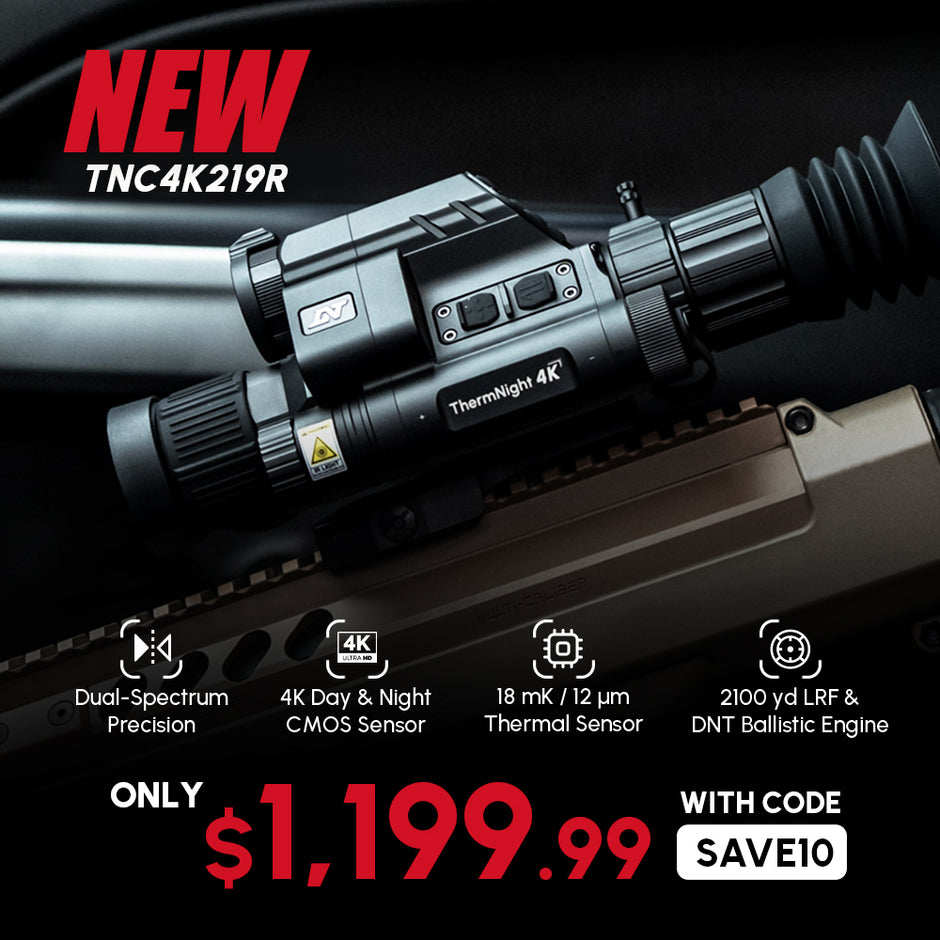
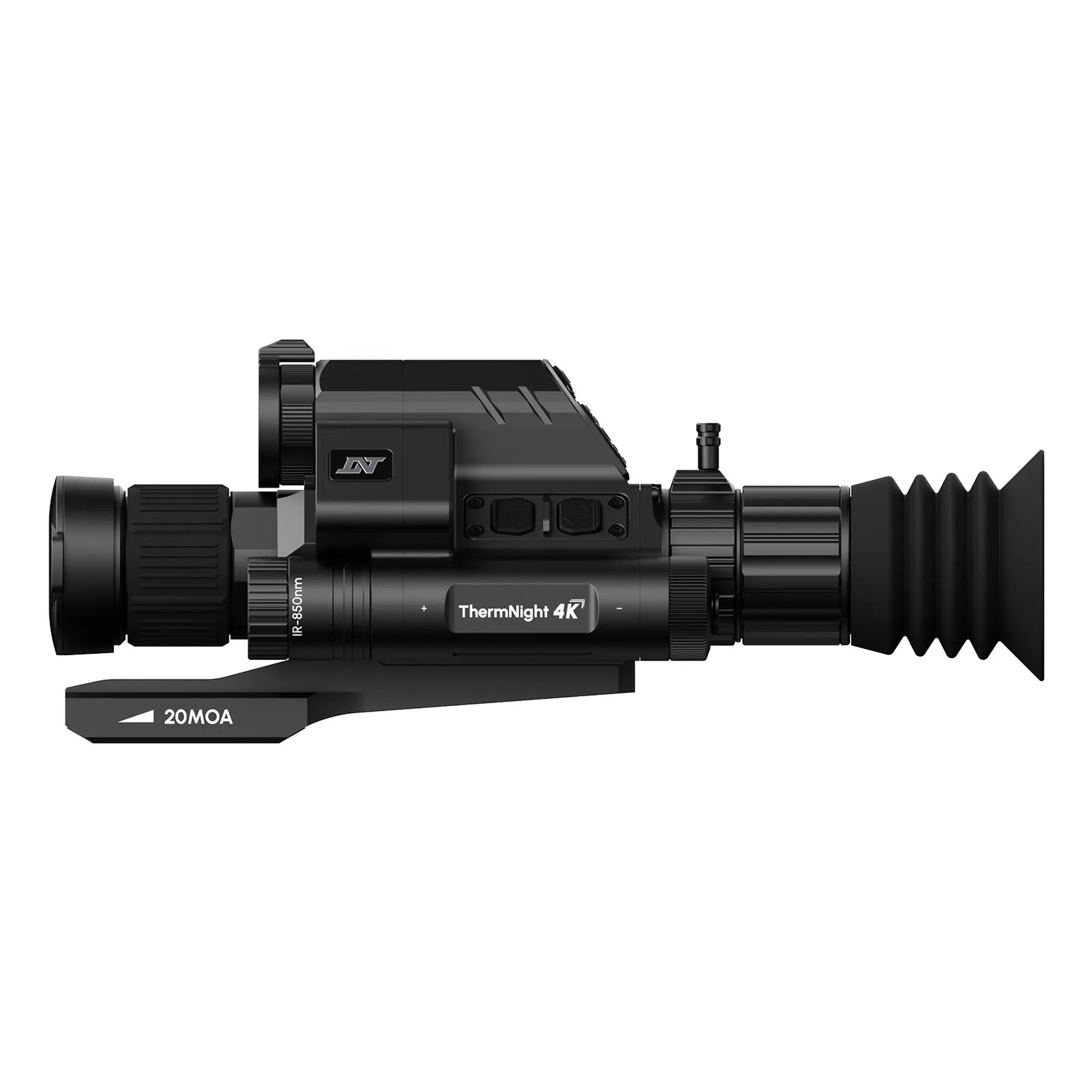


Quick Answer: The TNC4K219R is the more feature-rich option, while the TNC225R is the lighter and more compact choice. Choose the TNC4K219R for 4K day/night imaging, a wider thermal FOV, longer eye relief, advanced software, and a longer-range LRF. Choose the TNC225R if portability and simplicity are your priorities.
The most obvious difference between the DNT ThermNight TNC4K219R and TNC225R is image resolution. The TNC4K219R upgrades to 4K Ultra HD digital day & night imaging, delivering more detail for target identification than the TNC225R’s 1080P sensor.
But resolution isn’t the only difference. The two multispectral scopes also differ in thermal FOV, thermal sensitivity, LRF range, eye relief, software features, and overall weight. Let’s compare the key specifications and see what those differences mean in the field.
TNC4K219R vs. TNC225R: Core Specifications Compared
TNC4K219R vs. TNC225R: What Differences Matter in the Field?
See the difference in the field: Watch the TNC4K219R and TNC225R compared at 50, 100, and 150 yards to see how their field of view, image quality, and magnification perform in real-world conditions.
TNC4K219R vs. TNC225R at different distances
4K vs. 1080P: How Much Does Image Resolution Matter?
The TNC225R’s 1080P sensor handles basic target identification well. However, the TNC4K219R’s 4K Ultra HD sensor, paired with a 1080P Micro-OLED display, provides more detail for confident target recognition—helping you distinguish fur, antler tines, and brush obstructions at extended ranges.
Thermal FOV & Magnification: Which Scope Is Better for Scanning?
Both scopes use a 256×192 thermal core, but they take different approaches to viewing:
The TNC4K219R starts at 2x with a 9.2° × 6.9° thermal field of view, giving you a wider view for scanning and closer-range target acquisition. The TNC225R starts at 3x and reaches up to 12x digital thermal magnification, giving you more flexibility for detailed observation at range. The TNC4K219R's thermal core is also more sensitive at ≤18mK NETD, compared with ≤25mK on the TNC225R, for cleaner hot-spot definition in tough conditions.
App Ecosystem & Firmware Updates: Which ThermNight Scope Is Easier to Manage?
Software convenience is a key differentiator here:
-
TNC4K219R: Supports One Tap Connect via the DNT App for fast live-streaming and file transfers, alongside Over-The-Air (OTA) firmware updates directly through your phone.
-
TNC225R: Requires manually downloading firmware update files to a memory card/computer to flash the device.
Software Innovation: Which ThermNight Scope Offers More Automation?
The TNC4K219R introduces Thermal Auto Zeroing, which automatically syncs the thermal channel after zeroing the 4K day/night channel, reducing the need for separate manual thermal adjustments. The TNC225R uses manual thermal zeroing.
Eye Relief: Which Scope Offers More Comfortable Viewing?
The TNC4K219R offers 65 mm of eye relief, compared with 45 mm on the TNC225R. The longer eye relief provides a more forgiving viewing position, which can be especially useful when wearing glasses or shooting from less conventional positions.

Hunter aiming a rifle with a ThermNight TNC4K219R scope demonstrating 65mm eye relief
What Comes in the Box? Mounts, Batteries & Overall Value
Both optics offer strong out-of-the-box value, with each including two rechargeable batteries, a multi-port charger, and a standard mount. The TNC225R comes with 18650 batteries, while the TNC4K219R includes higher-capacity 21700 batteries.
The TNC4K219R goes a step further with two mounting solutions, including a QDS150 Quick Detach Mount and a PM20L mount. This gives you greater mounting flexibility across different rifle platforms without requiring an immediate aftermarket mount purchase.

ThermNight TNC4K219R scope unboxing contents including Quick Detach mount
Which DNT ThermNight Scope Fits Your Setup?
-
Get the TNC225R if: You want a slightly more compact optic, prefer a higher base optical zoom (5x), and don't mind updating firmware manually. [Choose TNC225R]
-
Get the TNC4K219R if: You want crystal-clear 4K identification, seamless app connectivity with OTA updates, a wider thermal scanning FOV, extended 2,100-yard LRF range, and extra mounting hardware included out of the box. [Choose TNC4K219R]
FAQs on TNC4K219R & TNC225R
Is the TNC4K219R better than the TNC225R?
It's more capable, not universally better. The TNC4K219R wins on image quality, comfort, rangefinding, and software; the TNC225R wins on weight, size, and thermal zoom reach. The right choice depends on your distances, terrain, and how much you value convenience features.
Which DNT ThermNight scope is better for hog or predator hunting at night?
For fast scanning across fields and all-night sits, the TNC4K219R's wider thermal FOV and dual-battery runtime have the edge. For lighter carry and close-range work around livestock or barns, the TNC225R is often the more practical pick.
Can both scopes be used in the daytime?
Yes. Both are true multispectral optics with full-color day modes—the TNC225R at 1080P, the TNC4K219R at 4K UHD—plus digital night vision with IR illumination and thermal imaging in one unit.
How far can the TNC4K219R and TNC225R laser rangefinders reach?
The TNC4K219R has a 2,100-yard LRF, while the TNC225R reaches 1,200 yards. For most hunting situations inside 400 yards, either provides ample ranging capability.