






One of the most challenging things about coyote hunting is that no two hunts are ever the same. You can put all the effort in and do everything right: the perfect spot, the perfect call sequence, even get a response, and still never see a coyote. Then, on the next stand, they come in when you least expect it.
That's what keeps it interesting. Every stand is a new challenge, and every hunt has the potential to turn into a story worth telling.

The only thing better than the thrill of the hunt and that feeling of success when you toss that first coyote of the night into the bed of the truck is making memories with those who share the same passion.
You can be very effective hunting alone, but I have never once had as much fun coyote hunting by myself as I do with someone who enjoys it just as much as I do. Especially when you call in a pair or a triple, those perfectly timed, simultaneous kill shots make for some epic memories.
The Hunt Behind the Story
One hunt in particular comes to mind often.
It was the weekend before Thanksgiving. A friend from Maryland was coming down to hunt coyotes, and a local buddy was joining us. He was making a six-hour drive just to hunt coyotes. This would be the second trip he had made down to North Carolina specifically to hunt. The first trip did not end in success.
This time needed to be better.
I planned and saved my best stands for the weekend, purposefully avoiding them for weeks beforehand in hopes they would produce and his trip wouldn't be for nothing again.
We pulled into our first spot, and I killed the headlights as we rolled in. I always park at least 100 yards away from where I plan to set up so I don't tip off any coyotes already in the area.
It's a 300-acre cattle farm with massive pastures on one side of the dead-end road and hay fields on the other, both surrounded by woods. We rolled the dice and chose the hay field side. We hopped out of the truck with stealth on our minds, carefully closing doors and being as quiet as possible.
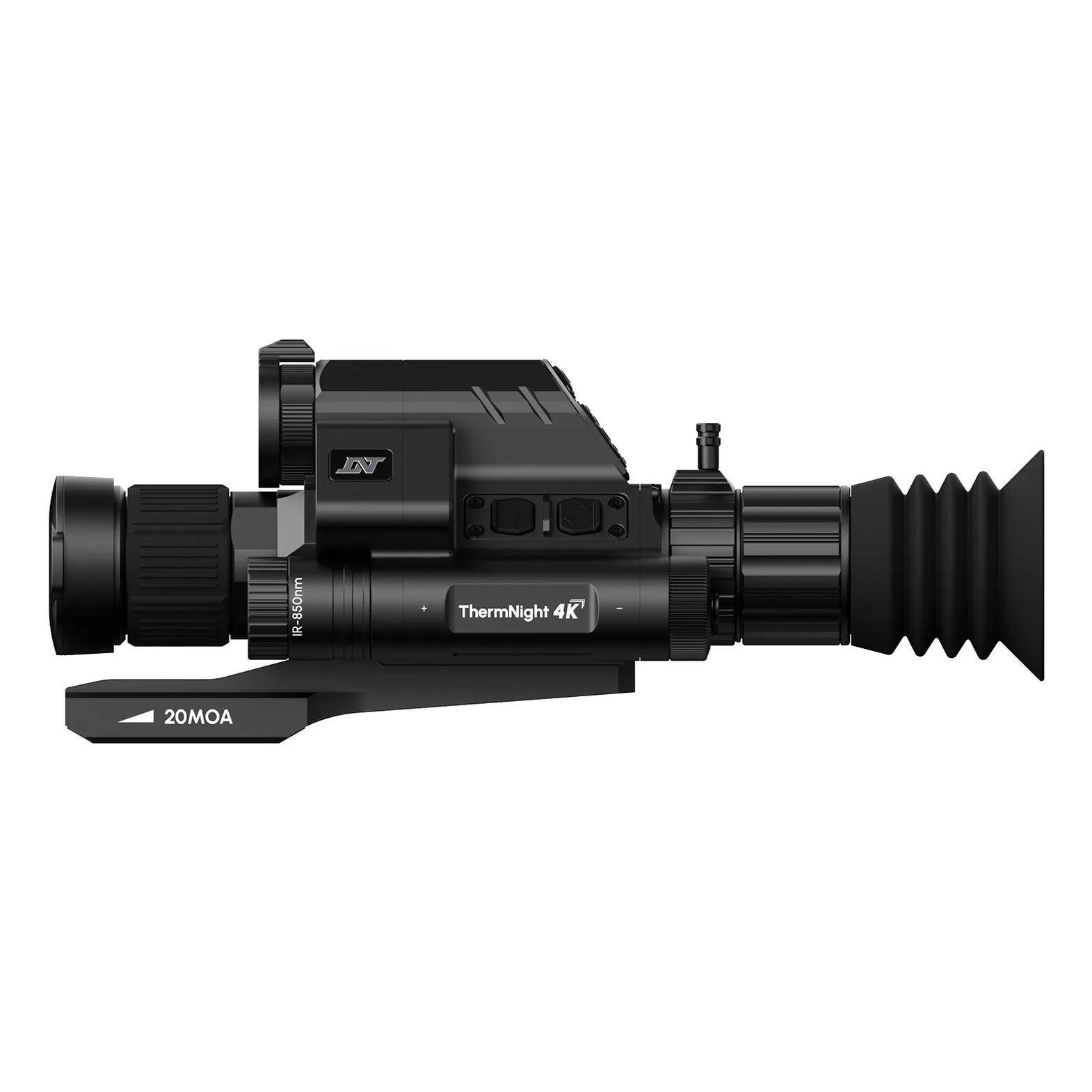
I always follow the same routine when unloading: tripod first, rifle secured and ready, ThermNight powered on and in standby mode (this conserves battery and prevents light from spilling out of the eyepiece while walking in the dark), then the call. Having a system allows me to get set up quickly while keeping noise and movement to a minimum.

I grabbed my tripod and carried it over my shoulder with the rifle secured. I find this to be the best way to transport everything because it allows me to deploy my tripod and rifle quickly with very little sound when I reach my stand.
We walked about 150 yards and set up in the moon-cast shadow of an old tobacco barn. There was little to no wind, and coyotes could come from any direction, so I placed the call about 30 yards directly in front of us. I powered up the caller remote and took the ThermNight out of standby mode.
It's go time.
Working a Call Sequence After Dark
After about five minutes of silence, I let out some FoxPro Freaky Squeaky at a low volume and gradually worked it up to about half volume. The high-pitched squeaks echoed back from the tree line, and the scanning began. Back and forth, I searched for that black-hot shape to appear on my screen.
About five minutes passed, and I changed the sound to MFK Rose Bud Cotton. Whenever I change sounds, I decrease the volume until I can no longer hear it, select the next sound, and then slowly bring the volume back up. I think it creates a more realistic transition than simply switching sounds in the middle of a sequence. Another five minutes passed with nothing spotted, and the woods remained silent. The only sounds were crickets and the faint barking of a distant domestic dog.
At that point, I pivoted to coyote vocals.
I cranked the volume nearly to max and played my favorite MFK lone howl, Juice Lonely Howl. The anticipation built as the sound projected into the star-filled night. I let the sequence run and muted it at the end. The sound disappeared into the tree line.
The Answer From the Pines
Silence.
Then, an answer.
A long, broken howl came from the opposite side of the road, deep in the pines, but close enough to be promising. What followed was a chorus of yips that sent a chill up my spine.
The three of us looked at each other, knowing a decision had to be made.
Do we stay put and continue calling? Or do we relocate to the other side of the farm?
A unanimous decision was made, and we quickly grabbed our gear and started hoofing it toward the howls, almost forgetting the call in our excitement. We were closing the distance, walking just past where we had parked the truck, when I decided to scan the cattle pasture across the road with my DNT Hound handheld thermal scanner.

"Wait!" I said. My buddies froze in their tracks.
It appeared to be two coyotes. I assumed they had come in to investigate the howls. They were roaming the pasture about 300 yards away, according to the Hound's built-in laser rangefinder.
Two Coyotes, One Tree, a Countdown
We quickly set up our tripod-mounted rifles, shoulder to shoulder like a firing squad. I tossed the call out in front of us and started playing cottontail distress at low volume.
It worked.
Looking through my DNT ThermNight 335R, I easily identified both coyotes using thermal and night vision simultaneously. Being able to scan with thermal while instantly confirming what I'm seeing with night vision is one of my favorite features of the optic.

Both coyotes were moving toward the call at a curious pace. Meanwhile, we were communicating.
"I'll take the left."
"You've got the right."
"Shoot on three."
One of the coyotes moved behind a tree while the other stayed visible. His pace slowed. Then he stopped. This was our chance.
I ranged him at 265 yards with the ThermNight's built-in laser rangefinder.
"Do we take him, or wait and see if we can get both?" one of them asked. Those decisions are hard when you don't know how the story ends. "Let's take him," the other replied.
"One... two... BOOM!"
The sound of three rifles firing almost blended into one. The coyote hit the dirt, legs stiff in the air. Immediately, we scanned for the second dog, but he had disappeared like a ghost behind the tree line. As the air cleared, reality started to sink in.
"Hell yeah!" I said.
We got a coyote, and that six-hour drive wasn't in vain. Not to mention it was a clean kill at 265 yards. A few minutes later, we decided to go retrieve our coyote.

The Retrieval: Thirty Head of Cattle and a Hot Extraction
There was only one problem.
By then, every cow in the pasture was making its way toward the downed coyote, including a rambunctious bull leading the charge. Within seconds, about 30 head of cattle had surrounded the coyote like a lynch mob. Now, I'm no cowboy, and neither were my friends, but the vibe we got from those cows was that they had some unfinished business with that coyote.
We passed through the gate into the pasture.
Our plan was simple: walk confidently toward the herd, clap and wave if necessary, and retrieve our coyote. I remember telling my friends, "This could get a little western," as we walked about halfway across the pasture.
Then, all hell broke loose.
Maybe it was the flashlights. Maybe it was just their nerves. Whatever the reason, they came charging. Feeling like rodeo clowns, we all turned and ran for the gate as fast as we could, yelling over our shoulders while the herd thundered behind us. We made it back to the gate without getting trampled and quickly put a barrier between ourselves and the cattle.
"We ain't leaving that coyote," my buddy said.
After a moment of laughter and disbelief, we came up with a new plan. One man on the gate. One man behind the wheel. One man doing the grabbing.
We executed the plan.
I drove up to the downed coyote while the herd moved in the opposite direction. My buddy jumped out, grabbed the coyote, tossed it into the bed of the truck, and jumped back in. We made a hot extraction from the pasture and locked the gate behind us.
Mission accomplished.
No man left behind... and no coyote either.
Three Coyotes, and the Part I Remember Most
We later went on to make two more successful stands that night, ending the hunt with three coyotes.

I'll leave you with this.
I remember that hunt more often than most, and it has very little to do with the three coyotes we killed. What sticks with me are the laughs, the chaos, and the memories made with good friends.
Coyote hunting is about more than filling a truck bed. It's about the experiences and stories that stay with you long after the hunt is over.
FAQs on Coyote Hunting
Is thermal or night vision better for coyote hunting?
Thermal imaging detects heat signatures and works in complete darkness, making it useful for locating coyotes. Night vision provides a more recognizable view of the surroundings, and using both technologies together can help hunters locate and confirm targets.
What magnification do you need for coyote hunting at night?
A base magnification of 2x to 4x is a useful starting point for many coyote hunting setups. Lower magnification provides a wider field of view for scanning, while higher magnification can help when observing distant targets in open terrain.
How far can you shoot a coyote with a thermal scope?
Effective shooting distance depends on image clarity, environmental conditions, equipment, and the shooter's abilities. In this hunt, the coyote was ranged at 265 yards using the DNT ThermNight 335R's built-in laser rangefinder.
Can a thermal scope detect coyotes through brush or fog?
Thermal scopes can detect heat signatures through gaps in sparse vegetation, but dense foliage and solid objects can block the view. Fog and rain can also reduce image quality and detection range, depending on conditions.
What features should you look for in a thermal scope for coyote hunting?
Consider image clarity, magnification, field of view, battery life, and ease of use in the dark. A built-in laser rangefinder can help measure distance, while features such as standby mode can be useful during nighttime hunts.