




Coyote hunting plays an important role in responsible predator management. As coyote populations continue to rise across much of the U.S., controlled hunting helps protect local wildlife and livestock while keeping ecosystems in balance.
At night, coyotes gain the advantage. But with the right approach, hunters can take it back. In this guide, we break down how to turn the night to your advantage.
 ZULUS HD V2 with a harvested coyote
Understanding Coyote Behavior at Night
Low-light conditions give coyotes confidence. They rely on darkness to move between cover, approach calls, and investigate potential prey with reduced risk.
Cold, clear nights in late fall and winter are often the most productive for coyote hunting. In low temperatures, coyotes burn more energy to stay warm, making them more responsive to calls when food sources are limited.
Effective Coyote Night Hunting Strategies
To improve your effectiveness during night hunts, focus on the strategies below.
Daytime Scouting
Use daylight hours to look for tracks, travel routes, and likely bedding areas. Knowing the layout ahead of time makes night movement safer and quieter.
Wind Awareness
Coyotes have an exceptional sense of smell. Always set up with the wind in your favor. They will often attempt to circle downwind before committing, using their nose to confirm what they’re hearing.
Strong winds can work against you, dispersing scent unpredictably and making coyotes more cautious and less responsive to calls.
Quiet Setup
From the moment you park, keep noise to an absolute minimum. Coyotes have extremely sharp hearing, something as simple as gear tapping together or a rifle bumping metal can end a stand before it starts.
 ThermNight with harvested coyotes
Calls
With a quiet setup, the only noise made should be from your call. Electronic or mouth calls that mimic distressed prey, specifically rabbit distress calls, are highly effective. However, other calls such as social type calls are also effective depending on the time of the year. Short calling sequences followed by quiet pauses work best, as they match natural prey behavior and give coyotes time to commit. Using an electronic call is a bit of science mixed with art. Knowing the psychology of coyotes will help you to know when and how to use certain calls. This is what can make a hunt successful or a not.
Decoys
Motion decoys can help hold a coyote’s attention once it’s already close, but they’re often hard to notice in complete darkness at longer ranges. Think of them as a finishing tool, not a long-distance attractant.
Shot Placement
For a humane harvest, aim for the heart or lungs when the coyote is standing broadside. This placement maximizes effectiveness and minimizes suffering.
 ThermNight with a harvested coyote
Choosing the Right Optics
Handheld Thermal + Digital Day & Night Vision
Among experienced predator hunters, combining a handheld thermal scanner with a digital night vision riflescope is widely regarded as the most effective approach to coyote hunting.
A lightweight handheld thermal like the HOUND allows fast, safe scanning without sweeping the area with a rifle. Because thermal detects heat rather than light, coyotes hidden in grass or brush stand out clearly even when they remain completely still. When a heat signature is detected, its integrated laser rangefinder and ballistic calculator provide precise ranging along with a ballistic solution for the shot.
Once a target is located, a digital day and night vision scope like the ZULUS HD series provides the clarity needed to positively identify targets. Details are clearly visible, helping ensure legal and ethical shots.
 ZULUS HD V2 paired with HOUND
3-in-1 Thermal Scope
Coyotes may blend into the night, but their heat signatures cannot. Traditional setups require two separate devices: one for scanning and one for shooting. HYDRA simplifies this with a true 3-in-1 design, functioning as a handheld monocular, a clip-on thermal, or a standalone thermal scope. While you could scan with a dedicated thermal scope mounted to your rifle, it is not ideal. Scanning while pointing your rifle everywhere can get tiresome very quickly. Even if the rifle is mounted to a tripod, this is no ideal either since moving the rifle to scan an area requires your body to maneuver around the tripod. With the Hydra, hunters can scan in handheld mode, then quickly mount HYDRA to the rifle via QDM150 multi-functional quick detach mount once a target is located. One hunter who owned HYDRA HS635 happily shared, "I took it coyote hunting for the first time last night and hit three coyotes at ranges varying from about 100-200 yards. Identification was no problem."
HYDRA also features AI-powered Image Super Resolution (ISR). Traditional low-resolution thermal images degrade quickly when digitally zoomed, making it difficult to distinguish an animal from terrain. ISR sharpens edges and reduces pixelation, improving clarity at higher magnifications.
 HYDRA used as a clip-on
Thermal + Digital Night Vision Fusion
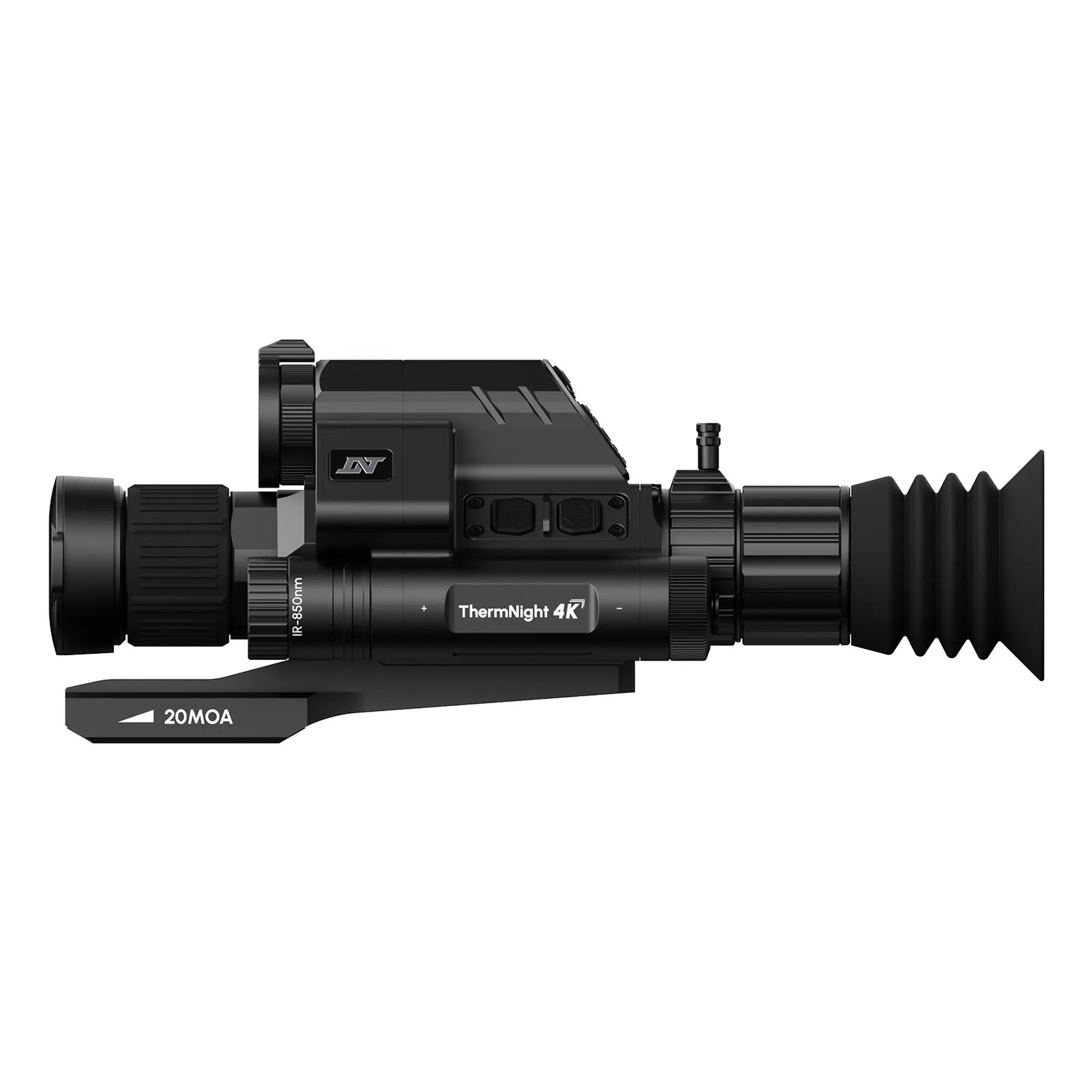
For long-range and high-difficulty coyote hunting, the DNT ThermNight series is purpose-built to solve one of thermal’s biggest challenges: positive identification.
ThermNight combines thermal imaging and digital night vision in one device. Hunters can detect heat signatures with thermal, then instantly switch to high-resolution night vision to confirm details, turning distant blobs of heat into clearly identifiable targets.
The Picture-in-Picture (PiP) feature lets you display thermal or night vision on either the main screen or PiP window, so you can track your target while monitoring the surroundings.
With built-in ranging and ballistic correction, ThermNight reduces distance-related guesswork when visibility is limited.
Designed for real-world use, all DNT digital scopes are IP67-rated and operate reliably from -20°C to 50°C (-4°F to 120°F), delivering consistent performance in harsh night-hunting environments.
 Picture-in-Picture on ThermNight
Safety and Legal Considerations
Coyotes are adaptable, but hunters must be even more disciplined.
Know the Rules
Many states allow year-round coyote hunting, but rules vary widely when it comes to electronic calls, magazine limits, night-hunting methods, and optic use. Make sure to check local regulations before you head out to the field.
Positive Identification
Never shoot at movement alone. You must clearly identify the target before firing to avoid non-target species or domestic animals.
Mind What’s Beyond
Always be aware of what lies beyond your target. In the dark, depth perception can be tricky. Use a rangefinder or scopes with built-in rangefinders to confirm distances and maintain safe shot angles.
 ZULUS HD V2 with a harvested coyote
Conclusion
Coyote night hunting is demanding, but highly rewarding. It blends traditional field skills with modern technology designed to overcome darkness.
With tools like DNT thermal and night vision optics, hunters can detect earlier, identify faster, and shoot with greater confidence, removing the limitations that night once imposed.
Remember, every coyote is different. What worked last night might not work tonight, and that's what makes the hunt a challenge.
Ready to level up your predator game? Explore the DNT Optics lineup and turn the darkness into your tactical edge.
Follow us @DNTOptics or join our Facebook group to connect with fellow members.