

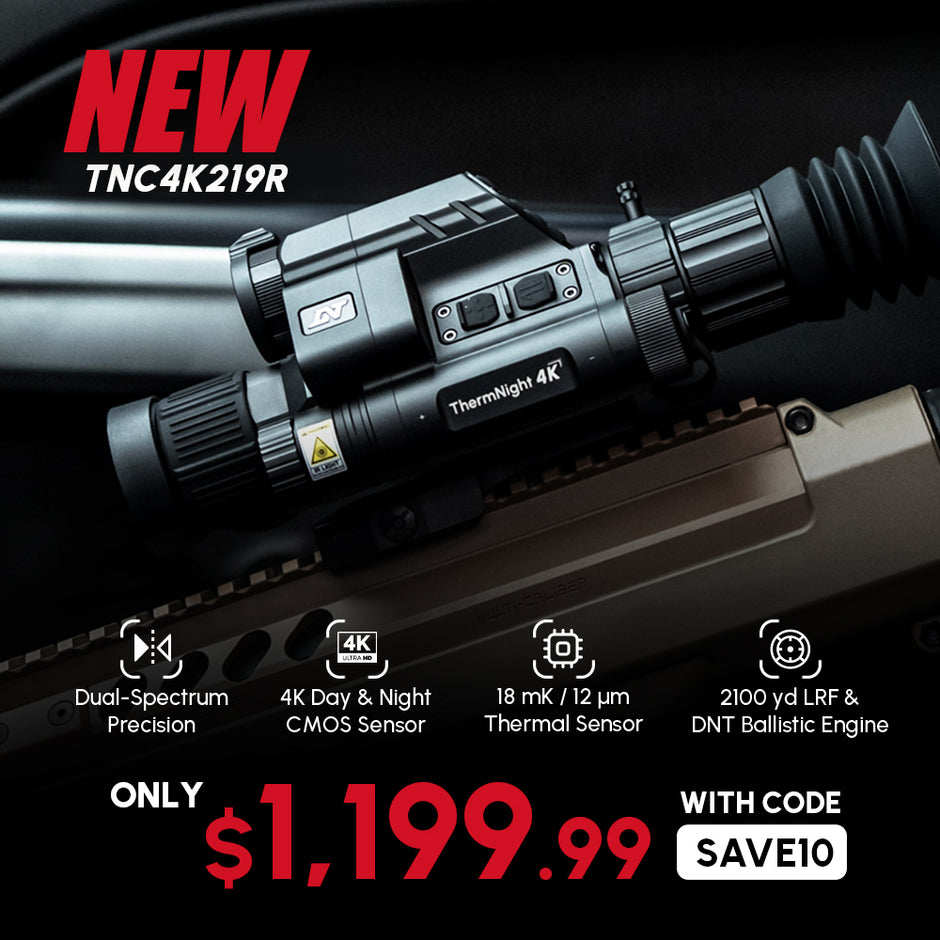
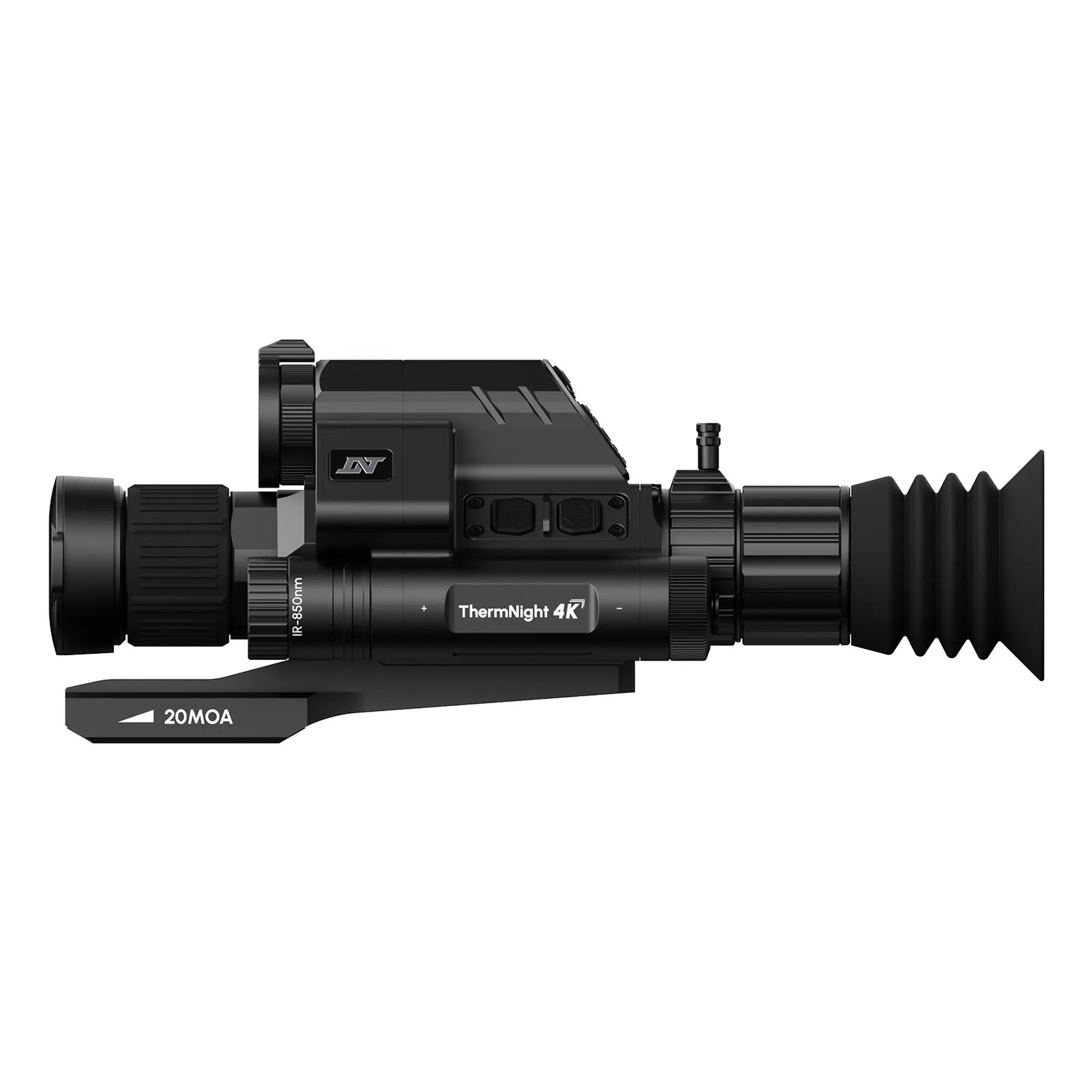


This article summarizes Texas Plinking’s hands-on testing and observations of the DNT ThermNight 4K (TNC4K219R). We appreciate his field testing and insights into the optic.
The DNT ThermNight 4K (TNC4K219R) combines a 4K digital day/night optic, thermal imaging, a laser rangefinder, and a ballistic calculator into one multispectral platform. In Texas Plinking’s hands-on testing, the optic was used for shooting at distances up to nearly 1,000 yards, with the 4K sensor helping make impacts and misses visible during long-range shooting.
This review covers its key features, field performance, night testing, and comparison with a separate HYDRA HS219 + ZULUS 4K setup.

DNT ThermNight 4K TNC4K219R at a Glance
4K Day/Night Mode: What Does the 4K Sensor Improve?
The TNC4K219R’s biggest upgrade over the previous ThermNight (TNC225R) is its 4K CMOS day/night sensor. Because this is a digital optic, zooming means cropping into the sensor image rather than magnifying optically — so sensor resolution determines how much detail remains at higher magnification.

The ThermNight 4K offers a 3–24x magnification range, with 3–6x remaining effectively lossless digital zoom. Beyond that, the image softens gradually as magnification increases.
-
In Texas Plinking’s testing, the 4K sensor provided enough detail to spot bullet splash and make corrections on steel at nearly 1,000 yards — something he found far harder with the previous Full HD generation.
-
The same 4K sensor powers digital night vision, paired with a detachable IR illuminator rated up to 450 yards.
Quick reference on resolution naming: HD = 1280×720, Full HD = 1920×1080 (the TNC225R’s sensor), and 4K UHD = 3840×2160 — four times the pixels of Full HD.
Thermal Mode: What Can You Expect From the 256×192 Sensor?
The TNC4K219R uses a 256×192, 12μm thermal sensor with ≤18 mK NETD sensitivity, paired with a 19mm objective lens. It offers 2x base magnification (up to 8x zoom) and a 9.2°×6.9° thermal field of view for scanning.
Key thermal features include:
-
Image Super Resolution (always enabled for enhanced detail)
-
Hotspot tracking (can be disabled)
-
Four color palettes: white hot, black hot, red hot, and iron hot
The 2x base magnification also provides a wider field of view for scanning.
Built-In Laser Rangefinder & Ballistic Calculator: How Do They Work?
The TNC4K219R combines a built-in laser rangefinder with DNT’s Ballistic Engine, allowing users to measure distance and receive ballistic corrections directly through the optic.

-
5-2,100 yard laser rangefinder
-
Two-step operation: press once to range the target, then press again to display the ballistic solution
-
10 ballistic profiles, linking zero settings, drop charts, and ballistic data
-
Profiles can be entered directly on the device or synced through the DNT App
-
With the included QDS150 Quick Detach Mount, users can switch between saved ballistic profiles for multiple rifles
Field Test: Shooting the ThermNight 4K to 1,000 Yards
The TNC4K219R was mounted on a Brenton USA Scout rifle — an 18-inch AR-15 chambered in 6 ARC, suppressed, and using 105-grain factory ammunition. Testing was conducted at a long-range facility with 10-20 mph gusting winds.
Zeroing was completed using One-Shot Zero at a short baseline distance.
The test then moved progressively farther out, with each stage shown in the matching video clip:
-
299 yards: 299 yd LRF reading; 1.2 MRAD holdover; impact visible in 4K.
-
498 yards: 498 yd range; 3.3 MRAD dialed; impact confirmed on steel.
-
816 yards: Ranged and dialed with a 3-mil wind hold; hit confirmed.
-
998 yards: 998 yd LRF reading; 10.7 MRAD dialed; final correction resulted in a confirmed hit.
The key takeaway was the 4K sensor’s ability to show impacts and misses at long range, allowing corrections during the shooting process.
After the long-range test, the optic was switched to thermal mode, with the thermal reticle automatically following the day zero via Thermal Auto Zeroing. The reviewer also used external heat on a steel target to demonstrate thermal detection.
Night Vision and Thermal Testing in Complete Darkness
The TNC4K219R was tested handheld in a pitch-black backyard, where even furniture was barely visible to the naked eye.
-
Digital Night Vision: With the IR illuminator at its lowest setting, the 4K sensor provided a clear view of the yard, including a rabbit that would otherwise have been difficult to see.
-
Thermal: At 2x magnification, a dog lying in the grass appeared as a bright heat signature. The warm spot where it had been lying remained visible even after the dog moved.
The practical difference: night vision amplifies available light for detail and identification, while thermal detects heat contrast. With both modes available, plus Picture-in-Picture, the TNC4K219R combines both functions in one optic.
Controls: Fast Access to Key Functions
The TNC4K219R provides dedicated controls for zoom, mode switching, and recording.
-
Thermal ↔ digital switching: One-button switching between thermal and 4K digital channels
-
Zoom: Throw-lever zoom ring for fast magnification changes
-
Picture-in-Picture: Keeps thermal detection visible while using the 4K digital channel for identification
-
Hotspot tracking: Highlights the hottest point in the thermal image and can be disabled
-
Recording: Supports onboard recording and recoil-activated recording
Gyroscope Cant Display & Zeroing: How Does the ThermNight 4K Help With Aiming?
The TNC4K219R combines a gyroscope, multiple zeroing options, and Picture-in-Picture for easier aiming across digital and thermal modes.
-
Cant-angle display: Shows rifle tilt in real time.
-
One-Shot Zero: Zero in one shot across day, night, and thermal modes.
-
Thermal Auto Zeroing: Thermal reticle follows the zero set in day mode.
-
Picture-in-Picture: Displays thermal information alongside the digital aiming view.
The TNC4K219R also eliminates the need for traditional parallax adjustment across its digital and thermal modes.
ThermNight 4K vs. HYDRA HS219 + ZULUS 4K
For users comparing an all-in-one multispectral optic with a separate thermal and digital day/night setup, the key difference is integration versus modularity. As Brandon from Texas Plinking points out, the all-in-one can also cost less.
DNT ThermNight 4K Pros and Cons
Pros
✓ All-in-one optic: Combines 4K day/night vision, thermal imaging, LRF, and ballistic calculation
✓ 4K digital sensor: Delivers detailed imaging for long-range observation and shooting
✓ Integrated LRF & ballistic solutions: Range targets and calculate shots without extra devices
✓ Proven performance: Tested by Texas Plinking at distances approaching 1,000 yards
✓ Complete package: Includes QDS150 Quick Detach Mount and PM20L 20 MOA Cantilever Mount
Cons
✗ 256×192 thermal sensor: Practical thermal performance, but not comparable to dedicated high-resolution thermal scopes
✗ No clip-on capability: Cannot be used as a front-mounted thermal attachment like HYDRA
✗ Learning curve: Multiple features require time to master
Final Thoughts: Is the DNT ThermNight 4K Worth It?
The DNT ThermNight 4K (TNC4K219R) is a worthwhile choice for shooters who want an all-in-one optic that combines day/night vision, thermal imaging, laser rangefinder, ballistic calculation, and multispectral PiP in a single system. The main limitation is its lack of clip-on capability, which means it is less flexible than a modular setup.
If your priority is having multiple capabilities integrated into one optic, the TNC4K219R is the better choice. If you need clip-on flexibility or prefer to have two independent devices, the HYDRA + ZULUS 4K setup offers greater modularity.
Ready to see what the ThermNight 4K can do? The TNC4K219R is available for $1,199.99 with code SAVE10. Get yours today!